December 31, 2020
My fire is in here.
I think I’m hot and running,
although if you’d ask me what are my thoughts are,
I will probably stall, and say wait — just give me a minute.
These thoughts don’t come running into my head as quickly as one might think.
What I need to do is go into my dream records, diaries or passages in journals. There I might find a record of something unhinged. In there has to be a spark of some kind. Everyday energetic thought lines can’t get to the heart of the matter quickly enough.
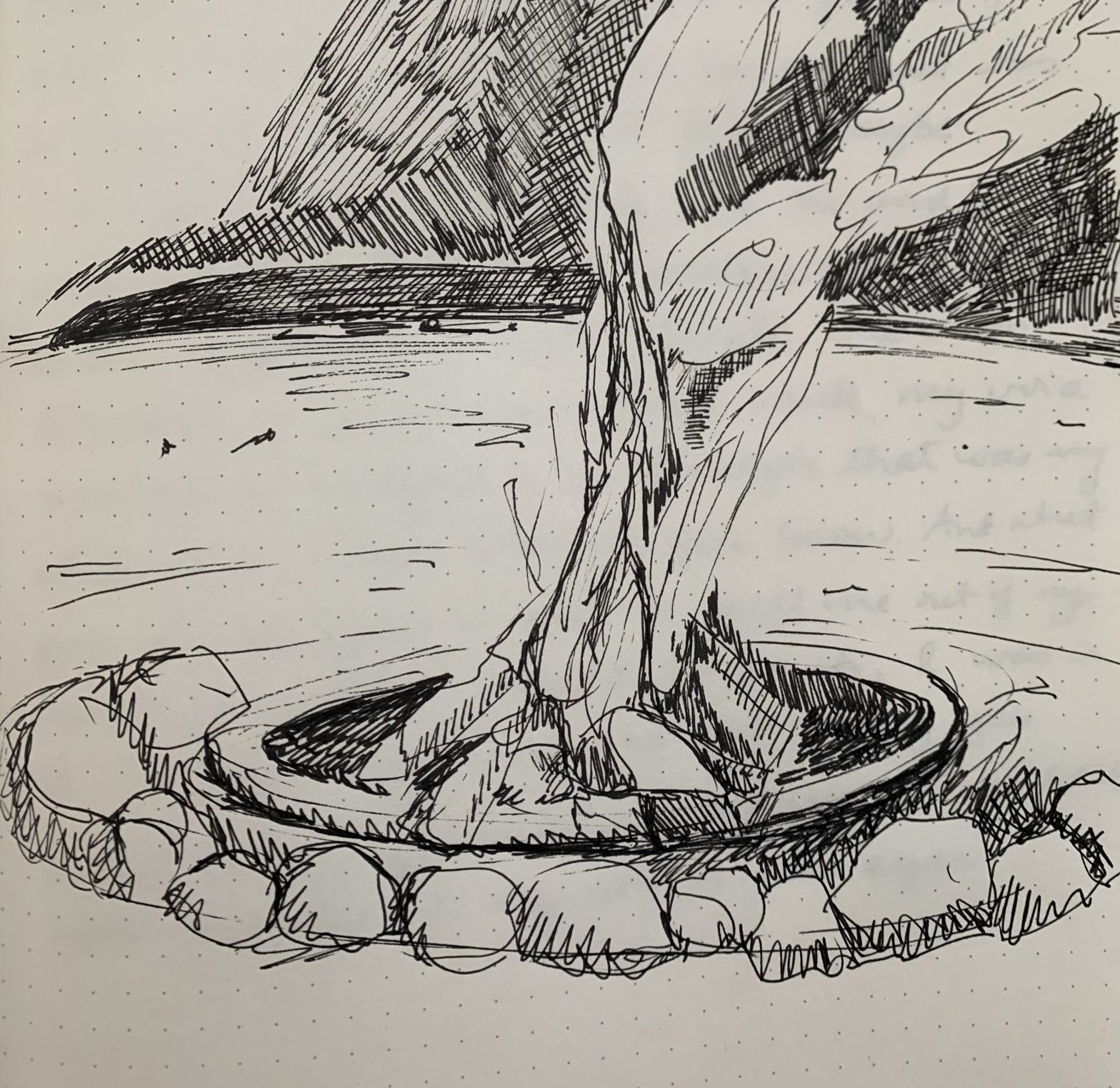
It turns out, it’s tomorrow again. My energy has ducked out of site. This happens frequently, in that I’ve lost the train of thought. I pick up my pen and draw. Trace the lines that start with other lines and I think I know that image that I’m after is a recurring one.
That reminds me. A long time ago, I was on my thousandth morning walk with the dog around the block. A routine walk before school, and a person comes towards me, a guy I don’t know, and he says to me, a 13-year old, ‘Hey, why the sad face?’, or maybe it was ‘It can’t be that bad?’. The comment simmered over me, though not because it was earth-shattering. It was the assumption, and the intrusion, and coercion.
Equivalent to ‘smile much?’. Something with the word ‘smile’, which would have been a colloquial construct meant to draw out a smile. Like or as. My smile simulacrum, let’s be clear, no voice needed, just respond to show I see his face and thereby reorient my expression. For what? What gives anyone the right to interrupt, to pull someone out. Maybe I’m being too defensive of my 13-year body response. But what the hell, I was so annoyed.
If I could have said it then – I could have snapped back. Not smiled or giggled. I could have shown some heat.
When I see my teens show heat now, for whatever reason, I want to sit back and wish them more oxygen. And despite my desire to draw words out of them so I can understand what their mood shields, I also want to respect the gravity of young interior space.
I trace that line around the smoke that rushes past me. Line after line, loops and the words drift. There is no direct flight. Bonfire lights the night for a moment.
 Anouchka Freybe